![teamecho-Logo-RZ-schwarz (1).png]](https://support.teamecho.com/hs-fs/hubfs/teamecho-Logo-RZ-schwarz%20(1).png?height=35&name=teamecho-Logo-RZ-schwarz%20(1).png)
Today's leaders are expected to react quickly and soundly to developments in their team – yet daily work life often leaves little time to systematically evaluate feedback. That is why we want to support you in correctly interpreting and categorizing your team's results, allowing you to derive concrete next steps for your team. It is not about merely analyzing isolated numbers. Rather, it is about understanding what your team currently needs and where you, as a leader, can take effective action.
1. Check Your Dashboard Setup
Before diving into the data, we recommend a quick but essential check on your dashboard: Am I looking at the right team?
Especially if you are responsible for multiple departments or work within matrix structures, this click is crucial. Always check the filter at the top to ensure the desired team (e.g., Accounting) is selected so that all subsequent key metrics are interpreted correctly.
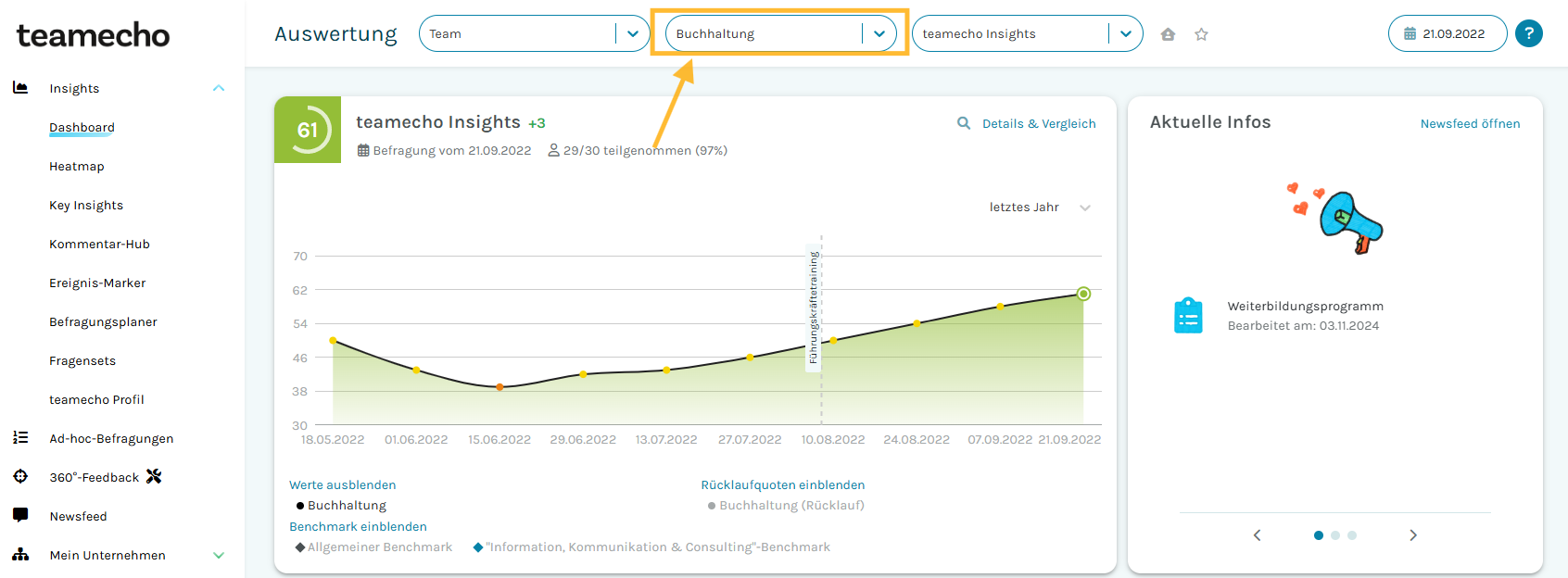
2. Evaluate Core Metrics: Index Value and Response Rate
The current survey round provides a quick initial orientation through two central metrics:
The Index Value (Your Satisfaction Barometer)
The index value reflects the overall satisfaction and mood in your team. To interpret this value correctly, the underlying dynamic is key. Therefore, always view this metric in comparison to the last survey:
- Value increased: Signals a positive development or the success of measures that have already been implemented.
- Value decreased: Indicates an acute need for action or new stress factors.
The Response Rate (Participation Rate)
Right next to the index value, you will see the response rate. It shows you precisely how many team members actively participated. This raises a central leadership question: Is the response rate already statistically significant – or does the team need a little more motivation?
💡 Leadership Focus
Dealing with Low Response Rates A low response rate is not a problem; it is a classic starting point for active leadership. It often indicates that your team still needs to be brought on board.
Your next step: Address the topic openly with your team. Explain that their feedback in teamecho is important to you, and appreciatively ask about the reasons for their hesitation. Often, it is just a matter of lack of time or uncertainties, which you can easily clear up in a brief conversation.
3. Structured Analysis: Comparing Categories
The categories embedded in teamecho structure your survey content and help you identify patterns quickly. When looking at the overview, pay close attention to both sides of the coin:
- Strengths and Resources: Where are your strengths and what is running stably? These areas are important Good to knows – they show you in black and white what you can build upon.
- Identifying Challenges: At the same time, you will immediately see where things are becoming more challenging – specifically, when a category score stands out significantly lower than the others (e.g., a sudden minus of three points in Organizational Culture).
With a single click, you can open the affected category to see its history across multiple surveys. This allows you to contextually evaluate the value perfectly: Is it a one-time spike (e.g., due to a stressful peak phase) or is a trend emerging?
4. Deep Dive Analysis: Individual Questions, Variance, and Comments
By looking at the underlying questions, you can go one level deeper to make the specific topic (e.g., a question about Company Values) tangible:
- Look at the Variance: It shows you whether there is a shared perception within the team (low variance) or if completely different viewpoints on the topic exist (high variance).
- Utilize Comments: The open-text comments provide highly valuable, deep feedback. They give the raw numbers the necessary context and help you understand why a topic was rated a certain way. Frequently, clear fields of action reveal themselves right here.
5. The Core Question for You: Team or Management Issue?
Now that you have analyzed the results and identified the topics, the decisive strategic classification as a leader follows:
“Do I need to bring this topic into the management meeting because it affects the entire organization? Or can the issue be handled directly within my own team?”
Let's stick with the example of Company Values:
- Team Level: Is it enough to make the values more visible within the team again (e.g., hanging them up in the office or discussing them in the next meeting)? If so, tackle it right away!
- Management Level: Does the problem run deeper because the values no longer structurally align with the company? Then this topic belongs at the management level to be collectively reflected upon or reviewed.
How to use? - 3 Steps to Impact
How to work with your results in daily practice – simple, fast, and effective.
- Address Topics Targetedly: Actively take the identified fields of action into your team meetings or regular touchpoints. Keep it short, clear, and to the point.
- Use the Right Power Tools: Use the Comment Hub to filter by specific time periods and see which topics are currently top-of-mind for your team. For a quick, visual overview, the Heatmap helps you recognize strengths and weaknesses at a glance through color-coding (Green, Yellow, Red).
- Create Transparency & Document: Utilize the Measures Newsfeed in teamecho to record what you have discussed together as a team and which next steps you want to set. This creates transparency in the feedback process and shows everyone in the team that their voice is heard and leads to real change.
Good 2 know: Save Time with Key Insights 🤓
If you want to save time during preparation, Key Insights has your back. Our artificial intelligence automatically summarizes the latest survey compactly, detects moods, and delivers directly actionable insights – ideal as a starting point or for preparing your team discussions.
Conclusion
With the right combination of dashboard analysis and open dialogue, leadership becomes more efficient: You get objective insights, clear fields of action, and more time for what truly matters – working with your team.